
The Connecticut Homeowner's Guide to Gravel Driveways
Topics Covered: Design • Installation • Maintenance • Repair • Materials • Pricing
Having a beautiful gravel driveway in Connecticut is one of the first things people notice about your home, but it's also one of the hardest-working parts of your property. Your driveway faces thousands of vehicle passes, snow plows, torrential downpours, oil leaks, and rushing Amazon delivery vans year after year.
Despite the work your driveway faces, it can also be a beautiful attraction to your property. The right gravel driveway material should not only look beautiful, but also perform well for years based on your property's unique conditions.
As one of Newtown’s top gravel driveway maintenance companies, each year we put hundreds of hours into our gravel driveways lay thousands of tons of material, and have dozens of happy clients who we help with gravel driveway design, installation, and maintenance.
This guide covers various factors in selecting, installing, maintaining, and even overhauling your gravel driveway, with guidelines around pricing, pros and cons of various materials, and more.
There is no "one-size-fits-all" driveway. The best solution depends on several important factors, including your budget, how you use the driveway, and the characteristics of your property. Our goal is to help you understand the advantages and trade-offs of each material so you can make an informed decision with confidence.
Before selecting a driveway material, we evaluate several key considerations:
Existing Driveway Condition – Is your driveway suitable for resurfacing, or does it require a complete reconstruction from the base up?
Drainage & Site Conditions – Slope, elevation changes, water runoff, soft soils, and surrounding terrain all play a major role in determining the best long-term solution.
Appearance & Curb Appeal – Your driveway should complement your home's architecture and landscaping while enhancing your property's overall value.
Maintenance Requirements – Some materials require periodic grading, sealing, or repairs, while others offer lower ongoing maintenance.
Durability & Longevity – Traffic volume, snow removal, freeze-thaw cycles, and heavy vehicles all influence how different materials will perform over time.
Budget & Long-Term Value – Initial installation costs should be balanced against expected maintenance expenses and service life.
Driveway Entrance (Apron) – Depending on municipal requirements and your preferences, the driveway entrance may be constructed using asphalt, Belgian block, cobblestone, or other complementary materials.
Most Common Gravel Driveway Materials
In Connecticut, the most common gravel driveway materials are process stone, gravel, and asphalt millings. Process driveways are a dense aggregate blend of crushed stone ranging from 1.25” down to stone dust, gravel comes in all shapes and stone types, and asphalt millings are recycled roadways and driveways that have been given a new life as a gravel like material that is cost effective and resilient.
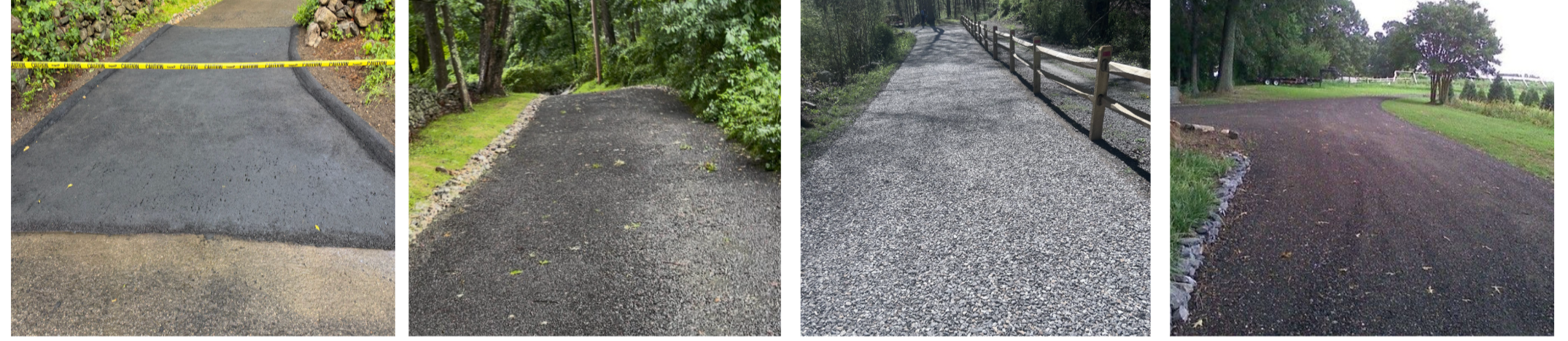
| Asphalt Apron | ¾" Process | ¾" Gravel | Asphalt Millings | |
|---|---|---|---|---|
| Description | Asphalt surface | Crushed stone ranging from ¾" down to stone dust fines | Crushed stone ¾" average size, no stone dust fines | Reclaimed asphalt, screened to ¾" and smaller |
| Color | Black | Installs brown, turns gray after rain | White & gray (color optional) | Black |
| Compaction | Maximum | Maximum | Medium | Maximum |
| Water permeation | Minimal (Water sheens to sides) | Minimal (Water sheens to sides) | Maximum (water permeates through) | Minimal (Water sheens to sides) |
| Asphalt paving considerations | — | Good – Used as base for paving | Medium – Requires removal or new base installed prior to paving | Medium – Requires removal or new base installed prior to paving |
| Base layer | — | 4-6" depth of 4" minus stone | 4-6" depth of 4" minus stone | 4-6" depth of 4" minus stone |
| Cost | — | $$ | $$$ | $ |
¾" Process Driveway
Overview
¾" Process (also called processed gravel, crusher run, dense grade aggregate, or DGA) is one of the most popular driveway materials in Connecticut due to its strength, affordability, and versatility. It consists of crushed stone ranging in size from ¾" down to stone dust (also called fines). When properly installed and compacted, the smaller particles lock together to create a dense, stable driving surface that resists rutting, erosion, and washouts.
While no gravel driveway is completely maintenance-free, ¾" process offers one of the best combinations of durability, value, and long-term performance for residential driveways.
Key Characteristics
Material: Crushed stone ranging from ¾" down to stone dust (fines)
Color: Installs with a natural brown appearance due to sand and fines, gradually weathering to a light gray after rainfall and exposure.
Compaction: ★★★★★ (Excellent)
Drainage: Minimal permeability. Water naturally sheds across the surface and into properly designed swales and drainage areas.
Paving Compatibility: Excellent. An ideal base material if you plan to pave with asphalt in the future.
Recommended Base: 4–6" of compacted 4" Minus crushed stone over stable subgrade (additional depth may be required for soft soils or heavy traffic).
Relative Cost: $$ (Excellent value)
Clean Gravel Driveway
Overview
Clean Gravel consists of uniformly sized crushed stone averaging approximately ¾" in diameter with no stone dust or fines to bond them together like process does. Because the stones do not lock together during compaction, the surface remains more open and permeable, allowing rainwater to drain directly through the driveway into the underlying base. This makes it an excellent choice for properties with drainage concerns or homeowners seeking a more natural, decorative appearance, without the dust or “country road” look of process.
While clean stone provides superior drainage, it does not compact as tightly as ¾" Process and generally requires more routine maintenance to redistribute loose stone and maintain a smooth driving surface during the course of the year.
Key Characteristics
Material: Uniform crushed stone averaging ¾" in size with no stone dust or fines.
Color: Natural white and gray stone (other colors and premium options are available)
Compaction: ★★★☆☆ (Medium)
Drainage: Maximum permeability. Water passes through the surface into the stone base below, reducing surface runoff and puddling.
Paving Compatibility: Medium. If future asphalt paving is planned, the clean stone layer typically must be removed or covered with a compactable base material before paving.
Recommended Base: 4–6" of compacted 4" Minus crushed stone over a properly prepared subgrade.
Relative Cost: $$$
Asphalt Millings Driveway
Overview
Asphalt Millings (also known as Reclaimed Asphalt Pavement (RAP)) are produced by milling the top layer of existing asphalt roadways and driveways. The reclaimed material is screened to approximately ¾" and smaller, retaining the original asphalt binder that helps the material compact into a firm, durable surface. When properly graded, compacted, and installed over a suitable stone base, asphalt millings provide an economical alternative to traditional gravel or new asphalt while offering a clean, dark appearance and reduced dust.
Although asphalt millings compact exceptionally well, they do not perform exactly like newly paved asphalt and may require occasional maintenance depending on traffic, weather, and installation conditions.
Key Characteristics
Material: Reclaimed asphalt pavement (RAP), screened to approximately ¾" and smaller.
Color: Rich black when installed, gradually weathering to a charcoal gray over time.
Compaction: ★★★★★ (Excellent)
Drainage: Minimal permeability. Water naturally sheds from the surface into properly designed swales and drainage systems.
Paving Compatibility: Medium. Existing millings are typically removed or covered with a properly engineered compactable base before installing new asphalt pavement.
Recommended Base: 4–6" of compacted 4" Minus crushed stone over a properly prepared subgrade.
Relative Cost: $
Asphalt Driveway Aprons
Overview
An asphalt driveway apron is the paved section of driveway that connects your private driveway to the public roadway. In many Connecticut municipalities—including Newtown and several surrounding towns—an asphalt apron is required for gravel driveways as part of local road and drainage standards. While requirements vary by municipality, the apron is commonly required to extend at least 15 feet from the edge of the roadway onto the property.
Beyond meeting local regulations, a properly installed asphalt apron provides a durable transition between the roadway and your driveway. It helps prevent gravel from migrating into the street, minimizes erosion at the driveway entrance, improves vehicle access, and creates a clean, finished appearance that enhances curb appeal.
Key Characteristics
Purpose: Provides a durable, paved transition between the public road and your driveway while helping contain gravel and reduce erosion.
Typical Length: Generally 15 feet or longer, depending on municipal requirements and site conditions.
Surface: 3" compacted hot-mix asphalt.
Base Construction: 4–6" of compacted ¾" Process (or larger compactable crushed stone) installed over a properly prepared and compacted stone base.
Drainage: Proper grading is essential to direct runoff away from the roadway and prevent water from pooling at the driveway entrance.
Edging Options: Asphalt edges may be finished with Belgian block (cobblestone) curbing, concrete curbing, or standard asphalt edges depending on aesthetics and budget.
Municipal Compliance: Requirements vary by town and should always be verified before installation.